
When you see a high-performance component—a supercar wheel, an aircraft's landing gear, or a professional rock-climbing carabiner—you are often looking at a piece of forged aluminum. But what does "forged" actually mean? It’s not just a fancy marketing term; it’s a manufacturing process that transforms a standard aluminum alloy into a material with superior strength, toughness, and reliability.
Forging is a process of shaping metal using localized, compressive forces. Think of it as a highly advanced, incredibly powerful version of a blacksmith hammering a piece of hot iron. Here’s what you need to know about this transformative process.
1. The Process: It's About Controlled Deformation
Forging aluminum doesn't involve melting or cutting away material. Instead, it starts with a solid block or bar of a specific aluminum alloy, called a "billet" or "ingot."
- Heating: The billet is heated to a precise temperature where it becomes malleable but remains solid.
- Shaping: The hot billet is then placed between two custom-made dies. An extremely powerful press or hammer then forces the dies together, squeezing the aluminum and forcing it to flow and conform to the exact shape of the die cavity.
This process of intense, controlled deformation is what gives forged aluminum its unique properties.
2. The Result: A Refined and Aligned Grain Structure
This is the most critical concept to understand. At a microscopic level, a standard block of aluminum has a random, crystalline grain structure, like a tightly packed box of sugar cubes.
When the aluminum is forged, this grain structure is broken down, refined, and forced to align with the physical shape of the part. Think of the difference between a piece of particle board and a solid piece of oak. The particle board has random grain, while the oak has a strong, continuous grain flow. Forging imparts this continuous "grain flow" to the metal, directing the material's strength along the contours of the component where it's needed most.
3. The Advantage: Superior Strength and Fatigue Resistance
Because of its refined and aligned grain structure, forged aluminum is significantly stronger and more durable than its non-forged counterparts.
- Compared to Casting: Casting involves pouring molten metal into a mold. This creates a random grain structure and can introduce microscopic defects like porosity (tiny air bubbles). Forging eliminates this porosity, resulting in a denser, more uniform material that is roughly 30% stronger and over 80% more fatigue-resistant than a casting of the same alloy.
- Compared to Machining: Machining a part from a solid block of aluminum (billet) is common, but the process cuts through the metal's natural grain structure, creating points of weakness. Forging aligns the grain with the shape, preserving its integrity and maximizing strength.
4. The Benefit: Lighter and More Reliable Parts
The superior strength-to-weight ratio of forged aluminum is its key engineering benefit. Because the material is inherently stronger, engineers can design parts that use less material to achieve the same or even greater strength.
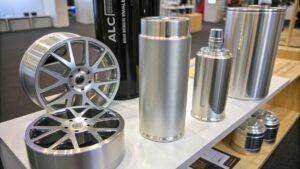
- Lighter Weight: This is why forged wheels are a premium upgrade on sports cars. They are lighter than cast wheels, reducing unsprung mass and improving suspension performance and handling.
- Higher Reliability: The absence of porosity and the enhanced fatigue resistance make forged components incredibly reliable. There are no hidden internal defects that could lead to unexpected failure under stress. This is why forged aluminum is mandatory for mission-critical applications.
5. The Application: Where Failure Is Not an Option
You will find forged aluminum in applications where the consequences of material failure would be catastrophic. The process is more expensive than casting due to tooling costs, but it is chosen when performance and safety are paramount.
- Aerospace: Landing gear, wing spars, structural bulkheads, and helicopter rotors.
- Automotive: High-performance pistons, connecting rods, suspension components, and premium wheels.
- Defense: Ordnance, structural vehicle components, and missile parts.
- Industrial & Recreation: High-pressure valves, heavy-duty lifting hooks, and high-end tools like wrenches and climbing gear.
In short, when you see "forged aluminum," you know you're looking at a part that was designed for maximum strength, minimum weight, and ultimate reliability.