

1. Material Composition & Manufacturing Process
5083 aluminum alloy (ASTM B209, EN 485, AMS 4027) is a non-heat-treatable Al-Mg alloy designed for extreme corrosion resistance and weldability. The H116 temper provides optimal combination of strength and stress corrosion resistance:
- Alloy Chemistry:
- Magnesium (Mg): 4.0-4.9% (solid solution strengthening)
- Manganese (Mn): 0.4-1.0% (grain refinement)
- Chromium (Cr): 0.05-0.25% (corrosion resistance)
- Iron (Fe): ≤0.40% max
- Silicon (Si): ≤0.40% max
- Base Material:
- Aluminum (Al): ≥94.5% (balance)
- Controlled Impurities:
- Copper (Cu): ≤0.10% max
- Zinc (Zn): ≤0.25% max
- Titanium (Ti): ≤0.15% max
Advanced Manufacturing Process:
- Direct Chill Casting: 680-720°C melt temperature
- Homogenization: 550°C for 8-10 hours
- Hot Rolling: Reduction at 400-450°C
- Controlled Cooling: Special cooling rate <100°C/min
- Stabilization Treatment: 150-180°C for 2-3 hours (H116 specific)
- Cold Rolling: Limited reduction <15% for surface quality
- Stress Leveling: Tension leveling for flatness
Certified to DNV, ABS, and Lloyds Register marine standards with full material traceability.
2. Mechanical Properties of H116 Temper State
| Property | Minimum | Typical | Test Standard | Marine Application Significance |
| Ultimate Tensile Strength | 275 MPa | 300-340 MPa | ASTM B557 | Exceeds marine structure requirements |
| Yield Strength (Rp0.2) | 175 MPa | 215-230 MPa | ASTM B557 | Retains strength at low temperatures |
| Elongation (50mm gauge) | 12% | 16-20% | ASTM B557 | Excellent ductility for forming |
| Shear Strength | 185 MPa | 210-230 MPa | ASTM B831 | 70% of tensile strength |
| Compressive Yield | 175 MPa | 200-215 MPa | ASTM E9 | Hull structure integrity |
| Fatigue Strength (10⁷) | 120 MPa | 140 MPa | ASTM E466 | Superior in saline environments |
| Hardness (Brinell) | 75 HB | 85 HB | ASTM E10 | Consistent through thickness |
| Impact Toughness (-20°C) | 25 J | 30 J | ASTM E23 | Arctic operation capability |
| Fracture Toughness | 40 MPa√m | 45 MPa√m | ASTM E399 | Critical crack tolerance |
3. Microstructure Control & Stabilization
H116 Specific Processing:
- Cold Work Reduction: 10-15% maximum
- Stabilization Treatment:
- Temperature: 150-180°C
- Duration: 2-3 hours
- Cooling: Controlled air cooling
- Purpose:
- Prevent β-phase precipitation (Al₃Mg₂)
- Maintain corrosion resistance
- Stabilize mechanical properties
Microstructural Characteristics:
- Grain Size: ASTM 5-6 (40-60μm)
- Intermetallic Phases:
- Al₆(Mn,Fe) dispersoids
- Fine β-phase inhibited
- Dislocation Density: 1-2×10¹⁰/cm²
- Textures: Weak rolling texture
- Recrystallization Fraction: 80-90%
- Phase Distribution: Uniform solute distribution
Stress corrosion resistance exceeds standard H321 temper by 30-40%.
4. Dimensional Specifications & Tolerances
| Parameter | Standard Range | Marine Tolerance | Commercial Tolerance |
| Thickness | 3-150 mm | ±0.5% | ±1% |
| Width | 1500-3500 mm | ±5 mm | ±15 mm |
| Length | 3000-16000 mm | +10/-0 mm | +25/-0 mm |
| Flatness | N/A | 3 mm/m max | 7 mm/m max |
| Camber | N/A | 1 mm/m max | 5 mm/m max |
| Edge Condition | Sheared | Machined edge | Plasma cut |
| Surface Roughness | 1.2-2.5 μm Ra | 0.8 μm Ra | 3.0 μm Ra |
Special Capabilities:
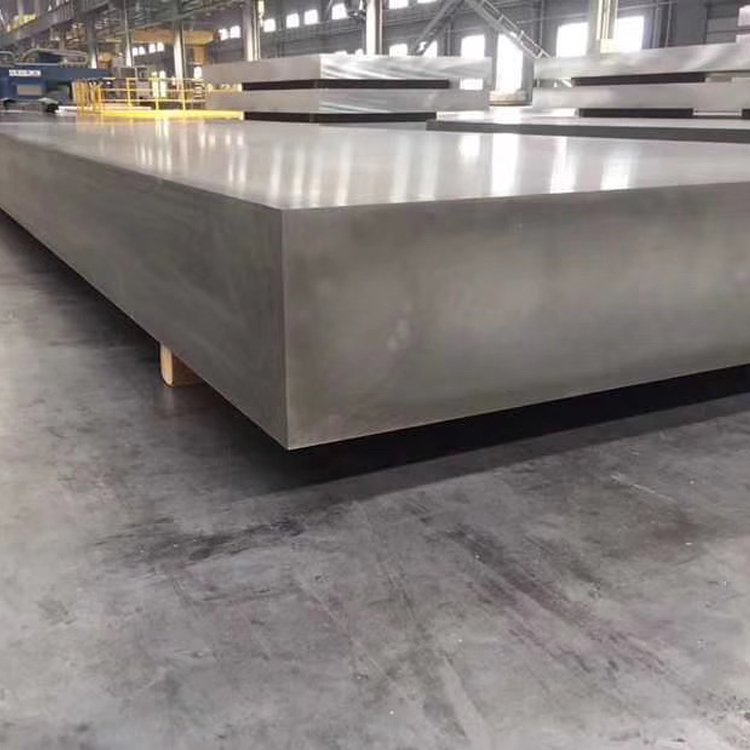
- Oversize Plates: Up to 4500mm wide × 20000mm long
- Ultrasonic Testing: Full plate scanning per ASTM B209
- Weight Formula: Thickness(mm) × Width(m) × Length(m) × 2.66 = Weight(kg)
5. Corrosion Resistance Performance
| Environment | Performance | Corrosion Rate | Industry Standard | Protection Methods |
| Marine Immersion | Excellent | <0.001 mm/yr | ASTM G50 | None required |
| Splash Zone | Excellent | 0.002-0.004 mm/yr | NORSOK M001 | Anodizing |
| Industrial Atmosphere | Excellent | 0.003-0.005 mm/yr | ISO 9223 | Powder coating |
| Seawater Cavitation | Good | <0.05 mm/yr | ASTM G32 | HVOF coating |
| Stress Corrosion | Excellent | No SCC at yield | ASTM G47 | None required |
| Galvanic Compatibility | Good | Low bimetallic current | ISO 8081 | Insulation kits |
Surface Treatment Options:
- Marine Grade Anodizing: 25-50μm
- Thermal Spray Aluminum (TSA): 150-300μm
- Marine Paint Systems: Epoxy/coal tar combinations
- Stainless Steel Cladding: Explosive bonding
- Chemical Conversion: Chromate-free technologies
6. Machining & Fabrication Properties
| Operation | Tool Material | Recommended Parameters | Marine Application Notes |
| Plasma Cutting | Hafnium electrodes | 400-600A, 100-250 IPM | Weld prep ready |
| Waterjet Cutting | Garnet abrasive | 0.8-1.2 kg/min, 300 mm/min | No HAZ distortion |
| Drilling | Carbide drills | Vc=60-100 m/min, fn=0.15 mm/rev | Self-lubricating design |
| Milling | PCD inserts | Vc=1000-1500 m/min | High surface finish |
| Forming | Press brakes | Min radius 3t (t=thickness) | Cold forming capability |
Fabrication Advantages:
- Weldability: Excellent without preheat
- Cold Working Capability: Up to 15% strain
- Repair Welding: No degradation
- Formability: Excellent in annealed state
- Grindability: Low tool wear
- Polishing: Accepts mirror finish
7. Welding & Joining Technologies
Recommended Welding Processes:
- Gas Metal Arc Welding (GMAW):
- Wire: ER5183, ER5356 or ER5556
- Shielding: Argon or Ar/He mixtures
- Friction Stir Welding (FSW):
- Parameters: 600-800 RPM, 150-300 mm/min
- Strength Ratio: 85-95% of base metal
- Laser Welding:
- Power: 4-8 kW fiber laser
- Speed: 2.5-5 m/min
- Stud Welding:
- Capacitor discharge type
Joint Design Specifications:
- Butt Joints: 60-70° included angle
- Fillet Welds: 6mm min leg length
- Double-Sided Welds: Preferred for >10mm thickness
- Interpass Temperature: <90°C maintained
8. Physical Properties for Marine Design
| Property | Value | Marine Application Significance |
| Density | 2.66 g/cm³ | Buoyancy calculations |
| Melting Range | 570-640°C | Fire safety margins |
| Thermal Conductivity | 117 W/m·K | Heat exchanger applications |
| Electrical Conductivity | 29% IACS | Shipboard electrical systems |
| Specific Heat Capacity | 900 J/kg·K | Thermal management in engines |
| Young’s Modulus | 70 GPa | Structural stiffness |
| CTE (20-100°C) | 23.8 ×10⁻⁶/K | Expansion joint design |
| Magnetic Permeability | 1.000022 | Degaussing compatibility |
| Thermal Neutron Cross-Section | 0.22 barns | Nuclear marine applications |
9. Quality Control & Certification
Testing Protocol:
- Chemical Analysis: OES for each melt
- Mechanical Testing: Each plate tested
- Corrosion Testing:
- ASTM G67: Nitric acid mass loss test
- ASTM G66: ASSET test for β-phase
- EXCO test per ASTM G34
- NDT Methods:
- Ultrasonic per ASTM B594 Level A
- Radiography for weldments
- Leak testing for tanks
- Macro/Micro Examination: Grain structure analysis
International Certifications:
- Marine Classifications: ABS, DNV, LR, BV
- Pressure Vessel Codes: ASME Section VIII
- Offshore Standards: NORSOK M-120/M-121
- Military Specs: MIL-DTL-24441
- International Standards: EN 1090 EXC3/4
- Welding Certifications: ISO 3834-2
- NACE Compliance: MR0175/ISO 15156
10. Industrial Applications & Handling
Primary Marine Applications:
- Ship hulls and superstructures
- Offshore platform decks
- LNG carrier containment
- Ballast water tanks
- Submarine pressure hulls
- Helicopter landing decks
- Marine riser systems
- Desalination plant components
Handling & Storage Protocol:
- Storage Temperature: 10-40°C
- Humidity Control: <60% RH
- Stacking Requirements:
- Wood spacers every 500mm
- Stack height limit: 1.2 meters
- Surface Protection:
- UV-resistant PE film
- VCI paper interleaving
- Lifting Equipment:
- Wide pad vacuum lifters
- Non-magnetic spreader beams
- Edge protection sleeves
Transportation Specifications:
- Seaworthy packaging
- Desiccant units in containers
- ISO container compatibility
- Weatherproof covering
- Specialized cradle systems
- Shock indicators for sensitive parts