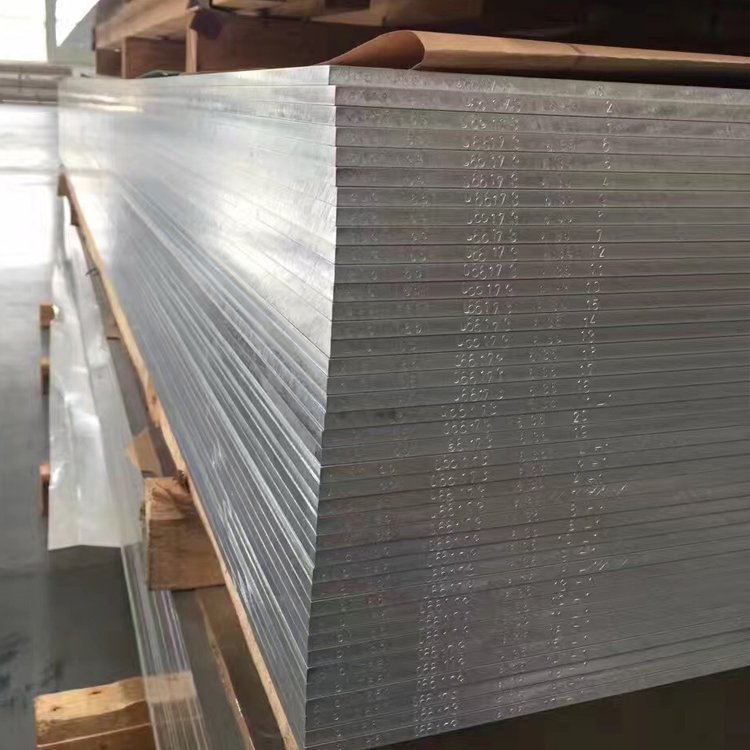

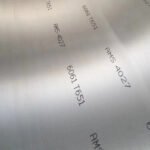
1. Material Composition & Manufacturing Process
6061 aluminum alloy (ASTM B209, AMS QQ-A-250/11) is a heat-treatable Al-Mg-Si alloy optimized for high strength-to-weight ratio applications. The T6 temper provides optimal mechanical properties through solution heat treatment and artificial aging:
- Alloy Chemistry:
- Magnesium (Mg): 0.8-1.2% (solution strengthening)
- Silicon (Si): 0.4-0.8% (precipitation hardening)
- Copper (Cu): 0.15-0.40% (enhanced machining)
- Chromium (Cr): 0.04-0.35% (grain control)
- Iron (Fe): ≤0.70% max
- Base Material:
- Aluminum (Al): ≥97.5% (balance)
- Controlled Impurities:
- Zinc (Zn): ≤0.25% max
- Titanium (Ti): ≤0.15% max
- Manganese (Mn): ≤0.15% max
Thermomechanical Processing:
- Direct Chill Casting: 680-710°C molten temperature
- Homogenization: 540-560°C for 8-12 hours
- Hot Rolling: Reduction at 430-490°C
- Cold Rolling: Final gauge reduction (15-25%)
- Solution Heat Treatment: 530°C ±5°C for 1-2 hours
- Water Quenching: Cooling rate >200°C/min
- Artificial Aging: 160-180°C for 8-12 hours
Certified to AMS 4025 and EN 485 standards with full traceability from billet to finished plate.
2. Mechanical Properties of T6 Temper State
| Property | Minimum | Typical | Test Standard | Notes |
| Ultimate Tensile Strength | 260 MPa | 310 MPa | ASTM B557 | Superior to T651 temper |
| Yield Strength (Rp0.2) | 240 MPa | 275 MPa | ASTM B557 | 95% retention at 100°C |
| Elongation (50mm gauge) | 10% | 12-17% | ASTM B557 | Higher in thicker sections |
| Shear Strength | 170 MPa | 205 MPa | ASTM B769 | 85% of tensile strength |
| Bearing Strength | 480 MPa | 530 MPa | ASTM E238 | e/D=2.0 condition |
| Fatigue Strength (10⁷) | 95 MPa | 110 MPa | ASTM E466 | R=-1 condition |
| Hardness (Brinell) | 95 HB | 100 HB | ASTM E10 | Consistent through plate |
| Impact Toughness (Charpy) | 14 J | 18 J | ASTM E23 | At room temperature |
| Fracture Toughness (K₁c) | 29 MPa√m | 34 MPa√m | ASTM E399 | T-L orientation |
3. T6 Heat Treatment & Microstructure Control
Precision Thermal Processing:
- Solution Treatment:
- Temperature: 529-533°C (±3°C control)
- Soak Time: 60 minutes minimum per inch thickness
- Atmosphere: Protective nitrogen environment
- Quenching Process:
- Transfer Time: <15 seconds furnace-to-quench
- Water Temperature: 20-40°C (chiller controlled)
- Agitation: Turbulent flow >1.5 m/sec
- Aging Treatment:
- Single Stage: 165-175°C for 8-10 hours
- Double Stage: 120°C/5hr + 175°C/8hr (special)
Microstructural Characteristics:
- Grain Size: ASTM 6-7 (50-100μm)
- Precipitate Phases:
- β” needle precipitates (5-50nm length)
- β’ rod-like phases (100-500nm)
- Secondary Precipitates:
- Al-Fe-Si dispersoids
- Mg₂Si hardening phases
- Dislocation Density: 4-6×10¹⁰/cm²
- Recrystallization Fraction: 75-90%
4. Dimensional Specifications & Tolerances
| Parameter | Standard Range | Commercial Tolerance | Precision Tolerance |
| Thickness | 3-150 mm | ±0.5-1.0% | ±0.1-0.3% |
| Width | 1000-3000 mm | ±10 mm | ±2 mm |
| Length | 2000-12000 mm | +20/-0 mm | +5/-0 mm |
| Flatness | N/A | ASTM B209 Class | 1/4 commercial spec |
| Surface Roughness | N/A | 0.8-1.5 μm Ra | 0.2-0.4 μm Ra |
| Squareness | N/A | ≤2 mm/1000 mm | ≤0.5 mm/1000 mm |
Special Capabilities:
- Oversize Plates: Up to 4500mm wide × 18000mm long
- Ultrasonic Calibration: ASTM B594 Level A
- Edge Conditions: Plasma cut, machined, or mill finish
- Weight Calculation Formula: Thickness (mm) × Width (m) × Length (m) × 2.703 = Weight (kg)
5. Corrosion Resistance & Surface Protection
| Environment | Performance | Corrosion Rate | Protection Method |
| Industrial Atmospher | Good | 0.005-0.02 mm/yr | Chromic acid anodizing |
| Marine Environments | Fair | 0.01-0.03 mm/yr | Fluoropolymer coating |
| Fresh Water | Excellent | Negligible | PTFE impregnation |
| Chemical Exposure | Varies | Acid-dependent | PVDF coating |
| Stress Corrosion | Good | SCC threshold>150MPa | Special tempering |
Surface Enhancement Options:
- Anodizing:
- Type II: 5-25μm thickness
- Type III: 25-75μm hardness
- Chemical Conversion:
- Chromate (Class 1A)
- Chromium-free alternatives
- Organic Finishes:
- Powder coating (60-120μm)
- Liquid coatings (EP, PU, Acrylic)
- Embossing Options:
- Diamond plate pattern
- Linear tread patterns
6. Machining & Fabrication Performance
| Operation | Tool Material | Recommended Parameters | Surface Quality |
| Milling | Carbide inserts | Vc=500-800 m/min, fz=0.1-0.3 mm | Ra 0.8-1.6 μm |
| Drilling | HSS-Co drills | Vc=50-80 m/min, fn=0.1 mm/rev | Hole tolerance H9 |
| Turning | PCD tools | Vc=800-1200 m/min | Ra 0.4-0.8 μm |
| Tapping | Spiral taps | Vc=10-15 m/min | 6H thread quality |
| Waterjet Cutting | 3800 bar abrasive | Speed=150-300 mm/min | ±0.15 mm precision |
Forming Characteristics:
- Bend Radius (Minimum):
- 90° bending: 1.5T (T=thickness)
- Cold forming: 2.0T minimum
- Elastic Springback: 1-3° compensation required
- Stretch Formability:
- Maximum elongation: 8-10%
- Strain hardening exponent: 0.08-0.12
7. Welding & Joining Technologies
Recommended Welding Processes:
- Gas Metal Arc Welding (GMAW):
- Wire: ER4043 or ER5356
- Parameters: 20-24V, 160-220A
- Gas: Argon (100%) or Ar/He mix
- Tungsten Inert Gas (GTAW):
- Electrode: Ceriated tungsten
- Amperage: 150-300A DCEN
- Friction Stir Welding (FSW):
- Tool rotation: 600-1200 RPM
- Travel speed: 150-350 mm/min
Post-Weld Heat Treatment:
- Solution heat treatment: Not recommended
- Aging Only: 165°C for 4-6 hours
- Natural Aging: T4 condition restored after 4 days
8. Physical Properties for Engineering Applications
| Property | Value | Application Significance |
| Density | 2.70 g/cm³ | Lightweight structural design |
| Young’s Modulus | 68.9 GPa | Stiffness calculations |
| Poisson’s Ratio | 0.33 | Finite element analysis |
| CTE (20-100°C) | 23.6 ×10⁻⁶/K | Thermal expansion consideration |
| Thermal Conductivity | 167 W/m·K | Heat dissipation applications |
| Electrical Conductivity | 40% IACS | Electrical enclosures |
| Melting Range | 582-652°C | High-temperature limitations |
| Magnetic Permeability | 1.00002 | Non-magnetic applications |
| Specific Heat Capacity | 896 J/kg·K | Thermal management systems |
9. Quality Control & Certification
Testing Protocol:
- Chemical Analysis: Spark OES for all shipments
- Mechanical Testing:
- Tensile tests: Each 2000kg lot
- Hardness: Multiple locations per plate
- Non-Destructive Testing:
- Ultrasonic: Per ASTM B594 Level A
- Dye Penetrant: ASTM E1417
- Corrosion Testing:
- ASTM G47 for SCC assessment
- ASTM G67 for intergranular corrosion
Certification Compliance:
- ISO 9001:2015 Quality System
- AS9100 Aerospace Certification
- NADCAP Accredited Heat Treating
- PED 2014/68/EU Compliance
- NACE MR0175/ISO 15156
- ASME Boiler and Pressure Vessel Code
- AMS 2770 Heat Treatment Standard
10. Industrial Applications & Handling
Core Application Sectors:
- Aerospace structural components
- Marine frames and decking
- Automotive chassis and frames
- Defense vehicle armor plating
- Robotics structural elements
- High-performance bicycle frames
- Semiconductor equipment
- Architectural structural elements
Storage & Handling Protocol:
- Storage Orientation: Vertical or flat with even support
- Environmental Controls:
- Temperature: 15-30°C
- Humidity: <60% RH
- Surface Protection:
- Protective plastic film
- VCI (vapor corrosion inhibitor) paper
- Stacking Requirements:
- Wood spacers every 300-500mm
- Maximum stack height: 1000mm
- Handling Equipment:
- Vacuum lifting systems
- Non-magnetic hooks
- Edge protectors on slings
Cutting & Fabrication Precautions:
- Plasma cutting parameter control
- Waterjet cutting angle precision
- Machining coolant requirements
- Pre-bending heat treatment considerations
- Post-weld aging recommendations