1. Material Composition & Manufacturing Process
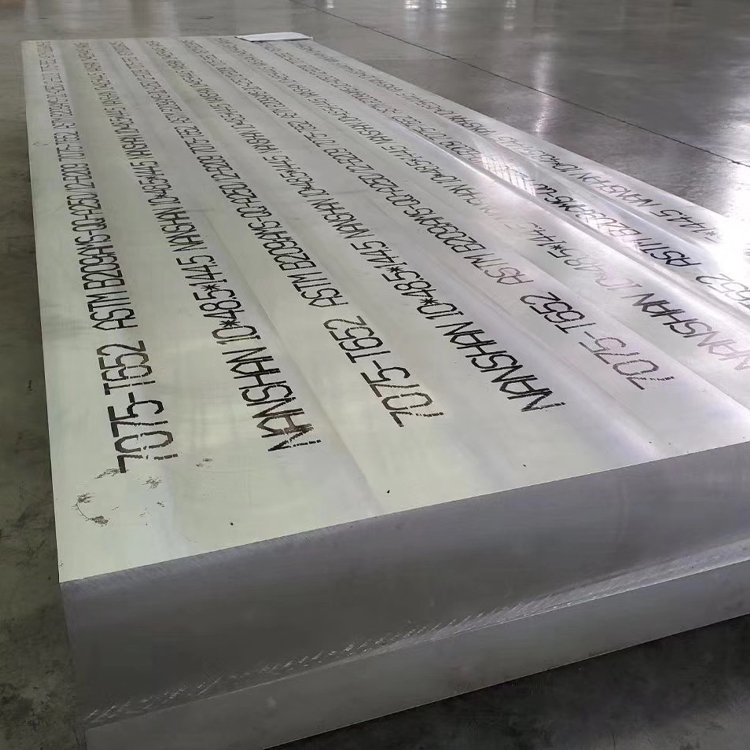
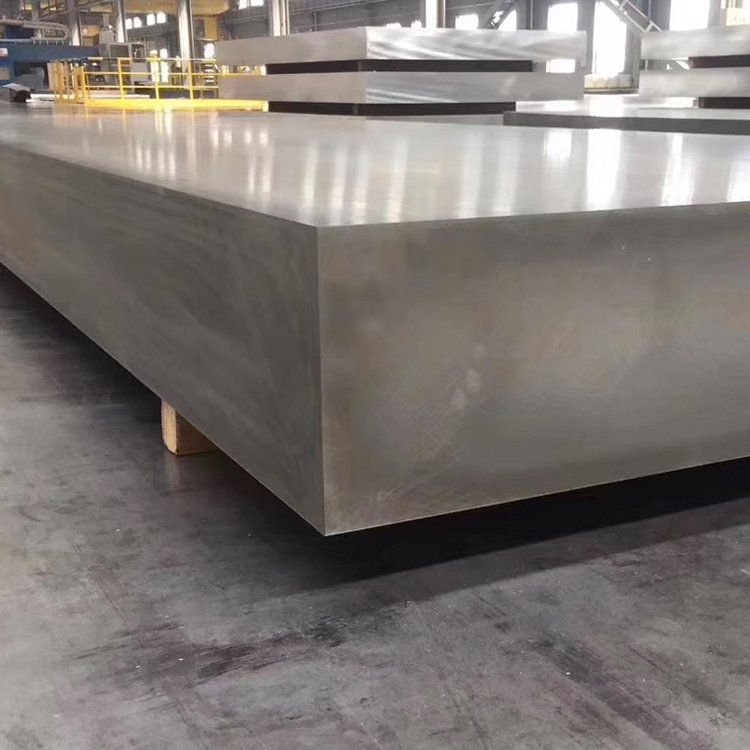
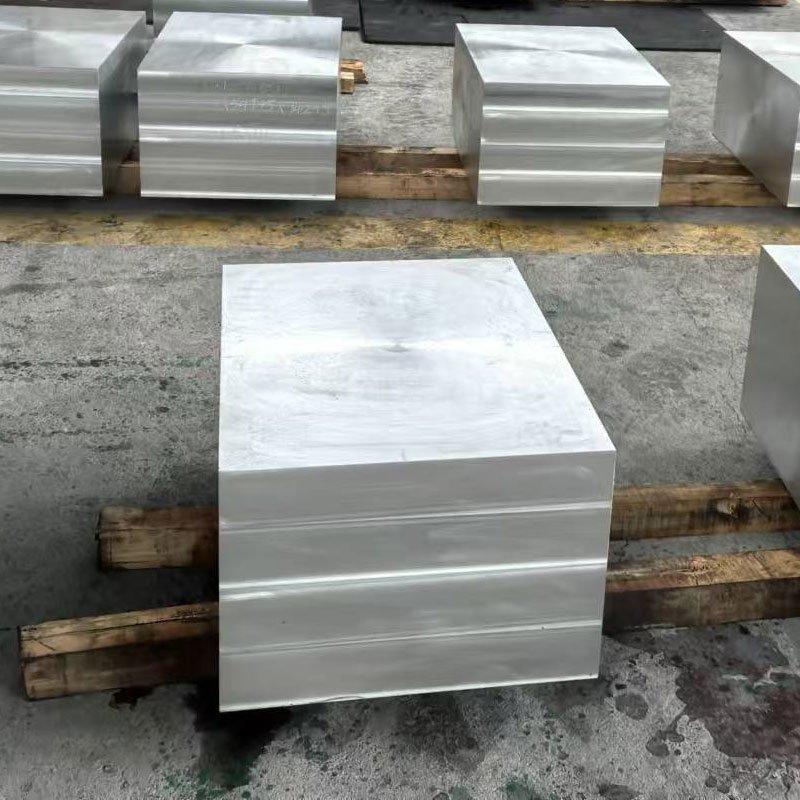
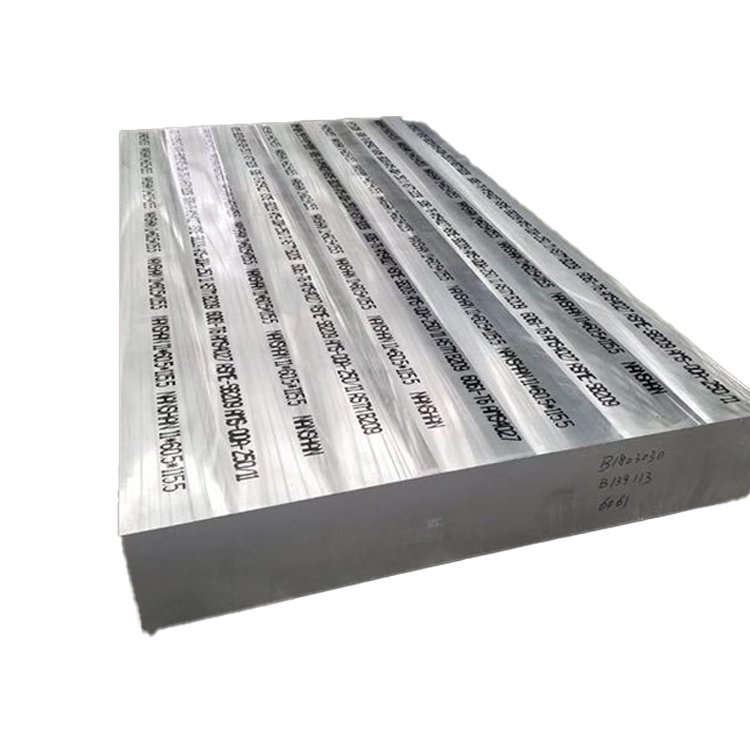
6061 aluminum alloy (ASTM B209, AMS 4025) is a heat-treatable Al-Mg-Si alloy engineered for versatility and excellent mechanical properties. Ultra-thick forged plate variants (>150mm) offer exceptional structural integrity through specialized manufacturing:
- Alloy Chemistry:
- Magnesium (Mg): 0.8-1.2% (Mg₂Si precipitation)
- Silicon (Si): 0.4-0.8% (Mg₂Si formation)
- Copper (Cu): 0.15-0.40% (strengthening)
- Chromium (Cr): 0.04-0.35% (corrosion resistance)
- Base Material:
- Aluminum (Al): ≥97.5% (balance)
- Controlled Impurities:
- Iron (Fe): ≤0.7% max
- Zinc (Zn): ≤0.25% max
- Titanium (Ti): ≤0.15% max
- Manganese (Mn): ≤0.15% max
Advanced Ultra-Thick Forging Process:
- Ingot Casting: Premium double-degassed 7000-12000kg ingots
- Pre-homogenization Inspection: Ultrasonic testing to Level A
- Homogenization: 580-590°C for 24-36 hours (core temperature controlled)
- Scalping: Surface machining to remove segregation zone
- Preheating: Staged heating to 450-470°C with ±5°C uniformity
- Open-Die Forging:
- Multi-directional deformation
- 10,000-15,000 ton hydraulic press
- Deformation ratio 3:1 minimum
- Intermediate Annealing: 410°C for 6-8 hours when required
- Solution Heat Treatment: 530-550°C for 2-5 hours (thickness dependent)
- Precision Quenching: Polymer quench with controlled cooling rate 45-90°C/min
- Straightening: Hydraulic press with distributed load
- Artificial Aging: T6 or T651 temper at 170-190°C for 8-12 hours
Full quality documentation with melt-to-product traceability.
2. Mechanical Properties of Ultra-Thick Forged Plate
| Property | Minimum | Typical | Test Standard | Significance for Ultra-Thick Sections |
| Ultimate Tensile Strength | 290 MPa | 310-330 MPa | ASTM B557 | Maintained through entire cross-section |
| Yield Strength (0.2% offset) | 240 MPa | 260-280 MPa | ASTM B557 | Less than 10% variation core to surface |
| Elongation (2 inch) | 8% | 10-14% | ASTM B557 | Critical for thick section ductility |
| Shear Strength | 170 MPa | 180-210 MPa | ASTM B769 | Joint design parameter for bolted connections |
| Bearing Strength (e/D=2.0) | 430 MPa | 450-480 MPa | ASTM E238 | Fastener hole performance |
| Fatigue Strength (10⁷) | 95 MPa | 100-120 MPa | ASTM E466 | Long-term cyclic loading resistance |
| Hardness (Brinell) | 95 HB | 95-105 HB | ASTM E10 | ≤5% variation through thickness |
| Fracture Toughness (K₁C) | 29 MPa√m | 32-37 MPa√m | ASTM E399 | Critical for damage tolerance |
| Through-Thickness Reduction | 6% min | 8-12% | ASTM E8 | Z-direction ductility |
Directionality (Typical Ratios):
- L vs. LT: ≤1.05:1 tensile strength ratio
- L vs. ST: ≤1.10:1 tensile strength ratio
- Core vs. Surface: ≤1.08:1 yield strength ratio
3. Ultra-Thick Forging Microstructure Control
Thickness-Specific Processing:
- Deformation Distribution:
- Multi-axial forge compression
- Minimum 25% reduction in final pass
- Constant temperature control through section
- Quench Rate Management:
- Polymer concentration: 12-18%
- Agitation velocity: 2.5-3.5 m/s
- Temperature rise control: <15°C max
- Thermal Gradient Mitigation:
- Isothermal holds at critical temperatures
- Core temperature monitoring during processing
- Controlled cooling rate: 60-80°C/min surface, 40-55°C/min core
Microstructural Characteristics:
- Grain Size: ASTM 4-6 (40-70μm)
- Recrystallization: >85% recrystallized structure
- Precipitate Distribution:
- Primary Mg₂Si: 0.5-2μm
- β” needles: 4-8nm in diameter
- Q-phase and B’-phase controlled
- Dispersoid Density: 1-3×10⁶/mm²
- Texture: Modified cube with reduced anisotropy
- Inclusion Rating: ≤0.5 per ASTM E45
- Maximum Grain Size Variation: 2 ASTM numbers through thickness
4. Dimensional Specifications & Tolerances
| Parameter | Standard Range | Precision Tolerance | Commercial Tolerance |
| Thickness | 150-500 mm | ±3 mm | ±5 mm |
| Width | 1000-3500 mm | ±5 mm | ±8 mm |
| Length | 2000-12000 mm | +15/-0 mm | +25/-0 mm |
| Flatness | N/A | 0.15% of length | 0.30% of length |
| Parallelism | N/A | 0.5% of thickness | 1.0% of thickness |
| Edge Straightness | N/A | 1 mm/1000 mm | 2 mm/1000 mm |
| Surface Roughness | N/A | 6.3 μm Ra max | 12.5 μm Ra max |
Specialized Parameters:
- Machining Allowance: 15mm per side recommended
- Stress Relief: Required before precision machining
- Ultrasonic Testing: 100% volumetric inspection
- Density: 2.70 g/cm³ (±0.01 g/cm³)
- Weight Formula: Thickness(mm) × Width(m) × Length(m) × 2.70 = Weight(kg)
- Maximum Single Piece Weight: 25,000 kg
5. Heat Treatment & Property Optimization
| Temper Designation | Process | Applications | Key Properties |
| T651 | Solution treated, stress relieved by stretching (1.5-3%), artificial aging | Primary aerospace, defense, moldmaking | Maximum strength with good stress corrosion resistance |
| T6511 | Solution treated, stress relieved by stretching (controlled), artificially aged | Critical structural components, precision parts | Excellent dimensional stability with high strength |
| T6510 | Solution treated, minimal stress relief, artificially aged | Complex geometries, bridge components | Balanced properties with minimized distortion |
| T73 | Solution treated, overaged | High temperature service, stress corrosion critical applications | Superior stress corrosion resistance, thermal stability |
Solution Heat Treatment Parameters:
- Temperature: 530-550°C
- Time: 25 min/inch of thickness (minimum 2 hours)
- Temperature Uniformity: ±5°C maximum variation
- Quenching Delay: <15 seconds maximum
- Transfer Equipment: Specialized handling fixtures
Artificial Aging Options:
- T6 Cycle: 175-185°C for 8-10 hours
- T651 Cycle: 175-185°C for 6-8 hours
- T73 Cycle: Dual stage (175°C/4hr + 215°C/8hr)
6. Machining & Fabrication Characteristics
| Operation | Tool Material | Recommended Parameters | Notes for Ultra-Thick Plate |
| Heavy Milling | Carbide inserts | Vc=300-700 m/min, fz=0.15-0.25 mm | Climb milling preferred |
| Deep Hole Drilling | Carbide drills | Vc=60-120 m/min, fn=0.15-0.30 mm/rev | Peck cycle required |
| Boring | PCD tooling | Vc=500-1000 m/min | Dampened boring bars essential |
| Face Milling | Carbide face mills | Vc=350-800 m/min | High positive rake geometry |
| Tapping | HSS-E-PM taps | Vc=15-30 m/min | H-limits preferred |
| Sawing | Carbide-tipped | 40-60 m/min, 2-3 teeth engaged | Flood cooling mandatory |
Special Considerations:
- Residual Stress Management: Release 75% of stock prior to final machining
- Fixturing: Distributed clamping force to prevent distortion
- Tool Engagement: Maximum 60% cutter diameter width of cut
- Coolant: High-pressure (70+ bar) for deep features
- Heavy Machining: Maximum 5mm depth of cut per pass
- Heat Generation: Monitor workpiece temperature during machining
- Chip Evacuation: Critical for deep pocket milling
7. Corrosion Resistance & Surface Treatments
| Environment | Performance | Protection Method | Service Life Expectation |
| Industrial Atmosphere | Very Good | Anodizing Type II/III | 15-20+ years |
| Marine Environment | Good | Chromate conversion + paint | 10-15+ years |
| Fresh Water | Excellent | Minimal protection needed | 30+ years |
| Chemical Processing | Fair to Good | PTFE impregnated anodize | Application specific |
| High Temperature | Fair | High-temperature coatings | 5-10+ years |
| Buried Service | Very Good | Bituminous coatings | 40+ years |
Surface Treatment Options:
- Anodizing:
- Type II: 10-25μm thickness
- Type III (Hard): 25-75μm thickness
- PTFE impregnated options
- Conversion Coatings:
- Chromate conversion (MIL-DTL-5541)
- Trivalent chromium treatments
- Non-chromate alternatives (Ti/Zr based)
- Painting Systems:
- Epoxy primer + polyurethane topcoat
- Powder coating (190-210°C cure)
- High-solids industrial coatings
- Special Surface Preparations:
- Mechanical: Grit blast Sa 2.5
- Chemical: Acid etch and desmut
- Laser texturing for specialized applications
8. Physical Properties for Design Engineering
| Property | Value | Significance in Ultra-Thick Applications |
| Density | 2.70 g/cm³ | Weight calculation for large components |
| Melting Range | 582-652°C | Stress relieving limitations |
| Thermal Conductivity | 167 W/m·K | Heat dissipation in large masses |
| Electrical Conductivity | 43% IACS | EMI shielding applications |
| Specific Heat | 896 J/kg·K | Thermal inertia in processing |
| Thermal Expansion | 23.6 ×10⁻⁶/K | Differential expansion in assemblies |
| Young’s Modulus | 68.9 GPa | Stiffness in structural applications |
| Poisson’s Ratio | 0.33 | Dimensional changes under load |
| Damping Capacity | 0.008-0.01 | Vibration characteristics |
| Thermal Diffusivity | 69 mm²/s | Processing heat transfer rate |
9. Quality Control & Testing Protocols
Mandatory Testing Protocol:
- Chemical Analysis: Optical emission spectroscopy
- Mechanical Testing:
- Tensile testing (surface, t/4, t/2 positions)
- Hardness survey (traverse and longitudinal)
- Non-Destructive Evaluation:
- Ultrasonic inspection per AMS-STD-2154 Class A
- Penetrant inspection of critical surfaces
- Metallurgical Evaluation:
- Grain size measurement per ASTM E112
- Inclusion rating per ASTM E45
- Microstructural analysis for precipitate distribution
- Dimensional Inspection:
- CMM verification of critical dimensions
- Laser scanning for profile accuracy
- Thickness mapping at defined grid points
Certification Package:
- Material Test Report (EN 10204 Type 3.1/3.2)
- Chemical composition certificate
- Mechanical property certification
- Heat treatment chart records
- NDT reports and acceptance criteria
- Dimensional inspection reports
- Traceability documentation (melt to product)
- Compliance declarations (RoHS, REACH, etc.)
10. Industrial Applications & Handling
Primary Applications:
- Aerospace structural components
- Defense system platforms
- Semiconductor manufacturing equipment
- Plastic injection mold bases
- Bridge structural elements
- Nuclear industry components
- Heavy transportation frames
- Machine tool structural bases
- Rolling mill backup rolls
- High-strength fixturing elements
Material Handling Protocol:
- Lifting Requirements:
- Minimum 4-point lifting system
- Spreader bars mandatory
- Maximum sling angle: 60° from horizontal
- Lifting capacity: Safety factor of 3:1
- Storage Conditions:
- Indoor storage recommended
- Support at minimum 300mm intervals
- Stacking height limitation: 1.5m maximum
- Avoid direct contact with dissimilar metals
- Transportation:
- Secure with non-metallic strapping
- Vibration dampening materials
- Edge protection mandatory
- Moisture protection during transit
- Machining Preparation:
- Temperature stabilization: 24 hours minimum
- Stress relieving recommended before critical machining
- Sequential material removal plan
- Progressive clamping force adjustment
11. Design Considerations for Ultra-Thick Sections
Structural Design Factors:
- Section Modulus Optimization:
- Utilize full thickness advantage for bending resistance
- I-beam equivalent performance with reduced weight
- Consider internal web structures in very thick sections
- Fastener Selection:
- Minimum edge distance: 2× bolt diameter
- Recommended thread engagement: 1.5× bolt diameter
- Torque specifications: 65-75% of standard steel values
- Bearing strength utilization up to 480 MPa
- Thermal Management:
- Allow for thermal expansion of 2.36mm per meter per 100°C
- Design expansion joints for large structures
- Consider thermal gradients during welding
- Dynamic Loading:
- Fatigue endurance limit approximately 100 MPa
- Apply stress concentration factors at design phase
- Shot peening for fatigue-critical surfaces
Weight Reduction Strategies:
- Pocket milling of non-critical areas
- Selective thickness distribution
- Hybrid structures with composite elements
- Topology optimization for