
1. Material Composition & Manufacturing Process
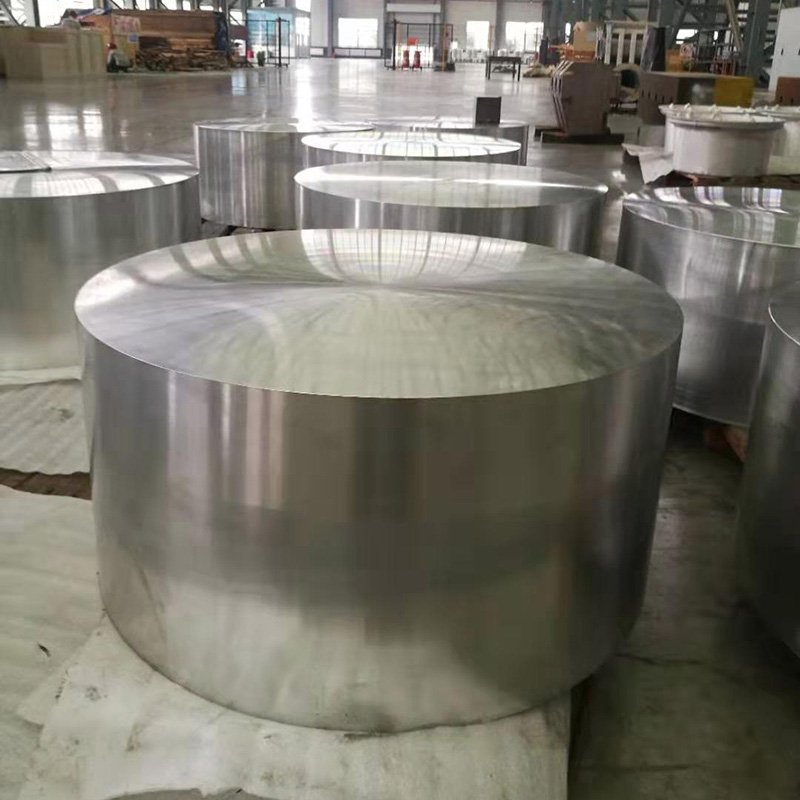
7075 aluminum alloy forged discs represent the pinnacle of aerospace-grade aluminum components, offering exceptional strength, fatigue resistance, and stress distribution for critical rotating and structural applications:
- Primary Alloying Elements:
- Zinc (Zn): 5.1-6.1% (principal strengthening element)
- Magnesium (Mg): 2.1-2.9% (enhances precipitation hardening)
- Copper (Cu): 1.2-2.0% (improves strength and stress resistance)
- Chromium (Cr): 0.18-0.28% (corrosion resistance and grain structure control)
- Base Material:
- Aluminum (Al): ≥87.1% (balance)
- Controlled Impurities:
- Iron (Fe): ≤0.50% max
- Silicon (Si): ≤0.40% max
- Manganese (Mn): ≤0.30% max
- Titanium (Ti): ≤0.20% max
- Other elements: ≤0.05% each, ≤0.15% total
Premium Forging Process:
- Melt Preparation:
- Primary high-purity aluminum (99.7% minimum)
- Precise alloying element additions with ±0.1% tolerance
- Advanced filtration through ceramic foam filters (30-40 ppi)
- SNIF degassing treatment (hydrogen < 0.10 ml/100g)
- Grain refinement with Al-Ti-B master alloy
- Direct-chill (DC) semi-continuous casting
- Homogenization:
- 460-480°C for 24-36 hours
- Uniform temperature control: ±5°C
- Controlled cooling rate: 15-25°C/hour
- Dissolution of coarse intermetallics
- Microsegregation elimination
- Billet Preparation:
- Surface conditioning (scalping)
- Ultrasonic inspection (100% volumetric)
- Preheating: 380-400°C for uniform temperature
- Forging Sequence:
- Open-die preforming: 380-410°C
- Closed-die finish forging: 360-390°C
- Hydraulic press capacity: 2,000-10,000 tons
- Computer-controlled ram speed and pressure
- Multi-stage forging for optimal grain flow
- Minimum reduction ratio: 3:1
- Solution Heat Treatment:
- 465-485°C for 1-4 hours (thickness dependent)
- Temperature uniformity: ±3°C
- Rapid transfer to quenching medium (<10 seconds)
- Quenching:
- Polymer-enhanced water quenchant
- Controlled agitation for uniform cooling
- Minimum cooling rate: 100°C/sec at surface
- Stress Relief:
- Controlled stretching (1-3% plastic deformation)
- Alternatively, compressive stress relief
- Artificial Aging (T6/T73 Tempers):
- T6: 120°C for 24 hours
- T73: Two-stage aging (107°C for 6-8 hours, followed by 163-177°C for 24-30 hours)
- Temperature uniformity: ±3°C
- Final Processing:
- Precision machining to near-net shape
- Surface treatment
- Nondestructive testing
- Dimensional verification
Full process traceability with computerized quality monitoring at all stages.
2. Mechanical Properties of 7075 Forged Discs
| Property | T6 Temper | T73 Temper | T7351 Temper | Test Method |
| Ultimate Tensile Strength | 570-595 MPa | 505-545 MPa | 510-550 MPa | ASTM E8 |
| Yield Strength (0.2%) | 495-525 MPa | 425-470 MPa | 435-480 MPa | ASTM E8 |
| Elongation (2 inch) | 8-12% | 10-14% | 10-14% | ASTM E8 |
| Hardness (Brinell) | 150-165 HB | 140-155 HB | 140-155 HB | ASTM E10 |
| Fracture Toughness (K1C) | 24-29 MPa√m | 31-37 MPa√m | 29-35 MPa√m | ASTM E399 |
| Fatigue Strength (10⁷ Cycles) | 160-190 MPa | 145-170 MPa | 150-175 MPa | ASTM E466 |
| Shear Strength | 330-350 MPa | 290-315 MPa | 295-325 MPa | ASTM B769 |
| Compressive Yield Strength | 520-550 MPa | 455-495 MPa | 465-505 MPa | ASTM E9 |
| Modulus of Elasticity | 71.7 GPa | 71.7 GPa | 71.7 GPa | ASTM E111 |
Property Distribution:
- Radial vs. Tangential: <5% variation in strength properties
- Surface to center variation: <8% for discs up to 150mm thickness
- Minimum properties guaranteed in all critical orientations
- Superior isotropy compared to rolled plate or extruded bar
- Stress corrosion cracking resistance (T73): >200 MPa threshold stress
3. Microstructural Characteristics
Key Microstructural Features:
- Grain Structure:
- Fine, equiaxed recrystallized grains
- ASTM grain size 6-8 (45-22μm)
- Uniform grain distribution across section
- Controlled grain flow pattern following forging contours
- Precipitate Distribution:
- MgZn₂ (η/η’) strengthening precipitates: 5-15nm
- CuMgAl₂ (S-phase) precipitates: Uniformly distributed
- Al₇Cu₂Fe intermetallics: Controlled size and distribution
- Al₁₂Mg₂Cr dispersoids: 50-200nm for recrystallization control
- Texture Development:
- Balanced texture with minimized directionality
- Forging-induced fiber texture optimized for isotropic properties
- Special fiber texture tailored for high fatigue resistance
- Special Features:
- Minimal precipitate-free zones (PFZs) at grain boundaries
- Controlled distribution of coarse intermetallics
- Fine dispersoid distribution for recrystallization control
- Optimized grain boundary character distribution
4. Dimensional Specifications & Tolerances
| Parameter | Standard Range | Precision Tolerance | Commercial Tolerance | Test Method |
| Diameter | 50-1500 mm | ±0.5mm up to 150mm | ±1.0mm up to 150mm | CMM |
| ±0.3% above 150mm | ±0.6% above 150mm | |||
| Thickness | 15-300 mm | ±0.5mm up to 50mm | ±1.0mm up to 50mm | Micrometer |
| ±1.0% above 50mm | ±1.5% above 50mm | |||
| Flatness | N/A | 0.5mm/m | 1.0mm/m | Dial gauge |
| Surface Roughness | N/A | 3.2 μm Ra max | 6.3 μm Ra max | Profilometer |
| Parallelism | N/A | 0.5mm | 1.0mm | CMM |
| Concentricity | N/A | 0.5mm | 1.0mm | CMM |
| Bolt Circle Diameter | As specified | ±0.2mm | ±0.5mm | CMM |
Standard Available Forms:
- Diameters: 50mm to 1500mm
- Thickness: 15mm to 300mm
- Profile variations: Flat, stepped, contoured
- Surface conditions: As-forged, machined, heat-treated
- Near-net shape capabilities for reduced machining
- Custom forgings with integral features (bosses, lugs, etc.)
5. Temper Designations & Heat Treatment Options
| Temper Code | Process Description | Optimal Applications | Key Characteristics |
| T6 | Solution heat treated and artificially aged | High-strength applications | Maximum strength and hardness |
| T651 | T6 + stress relieved by stretching | Critical structural components | Improved stress distribution |
| T73 | Solution heat treated and overaged | Stress corrosion critical applications | Superior SCC resistance with reduced strength |
| T7351 | T73 + stress relieved by stretching | Critical aerospace components | Excellent balance of properties |
| T76 | Modified overaging treatment | Balanced property requirements | Compromise between T6 and T73 |
Temper Selection Guidance:
- T6/T651: Maximum strength and fatigue resistance requirements
- T73/T7351: Stress-corrosion critical applications
- T76: Balanced properties for general aerospace applications
6. Machining & Fabrication Characteristics
| Operation | Tool Material | Recommended Parameters | Comments |
| Turning | Carbide, PCD | Vc=150-300 m/min, f=0.1-0.3 mm/rev | Sharp tools essential |
| Face Milling | Carbide, PCD | Vc=200-400 m/min, fz=0.1-0.2 mm/tooth | High-positive rake angles |
| Drilling | Carbide, TiAlN coated | Vc=80-120 m/min, f=0.15-0.30 mm/rev | Through-coolant drills preferred |
| Tapping | HSS-E-PM, TiCN coated | Vc=15-25 m/min | Form taps for critical threads |
| Reaming | Carbide, PCD | Vc=60-90 m/min, f=0.2-0.4 mm/rev | H7 tolerance achievable |
| Boring | Carbide, PCD | Vc=200-300 m/min, f=0.1-0.3 mm/rev | Balanced boring bars for vibration control |
Fabrication Guidance:
- Machinability Rating: 70% (1100 aluminum = 100%)
- Surface Finish: Good (Ra 0.8-3.2μm achievable)
- Chip Formation: Short to medium chips with proper tooling
- Coolant: Water-soluble emulsion (8-10% concentration)
- Tool Wear: Moderate with proper parameters
- Cutting Forces: Higher than other aluminum alloys
- Material Removal Rate: Up to 2000 cm³/min possible with robust setups
- Residual Stress Control: Critical for aerospace components
- Thin-wall Machining: Careful approach to minimize distortion
- Heat Generation: Monitor to avoid localized overheating
7. Corrosion Resistance & Protection Systems
| Environment Type | Resistance Rating | Protection Method | Expected Performance |
| Industrial Atmosphere | Fair | Anodizing + paint | 3-5 years with maintenance |
| Marine Environment | Poor | Anodizing + chromate + paint | 2-3 years with maintenance |
| High Humidity | Fair | Anodizing Type II | 1-2 years without additional protection |
| Stress Corrosion | Poor in T6, Good in T73 | Proper temper selection | Application specific |
| Exfoliation | Poor in T6, Good in T73 | Proper temper selection + protection | Critical for marine applications |
| Galvanic Corrosion | Poor with carbon steels | Isolation or sacrificial protection | Requires careful design |
Surface Protection Options:
- Anodizing:
- Type I (Chromic): 2-8μm (aerospace grade)
- Type II (Sulfuric): 10-25μm (general purpose)
- Type III (Hard): 25-75μm (wear resistance)
- Sealing options: Hot water, dichromate, nickel acetate
- Conversion Coatings:
- Chromate per MIL-DTL-5541 Class 1A
- Non-chromium alternatives for environmental compliance
- Painting Systems:
- Epoxy primer + polyurethane topcoat
- Aerospace-qualified systems per OEM specifications
- Advanced Protection:
- Sol-gel pretreatments
- Plasma electrolytic oxidation
- Ion vapor deposition (IVD) aluminum coating
8. Physical Properties for Engineering Design
| Property | Value | Design Consideration |
| Density | 2.81 g/cm³ | Weight calculation for rotating components |
| Melting Range | 477-635°C | Heat treatment limitations |
| Thermal Conductivity | 130-150 W/m·K | Thermal gradient analysis |
| Electrical Conductivity | 33-40% IACS | Electrical applications design |
| Specific Heat | 860 J/kg·K | Thermal mass calculations |
| Thermal Expansion (CTE) | 23.4 ×10⁻⁶/K | Thermal stress analysis |
| Young’s Modulus | 71.7 GPa | Deflection and stiffness calculations |
| Poisson’s Ratio | 0.33 | Structural analysis parameter |
| Damping Capacity | Low | Vibration analysis for rotating components |
Design Considerations:
- Operating Temperature Range: -60°C to +120°C
- Property Retention: Excellent below 100°C, gradual degradation above
- Stress Relaxation: Minimal below 100°C
- Fatigue Life: Superior due to forged microstructure
- Notch Sensitivity: Moderate (improved in T73 temper)
- Cryogenic Performance: Good strength retention at low temperatures
- Spin Testing Requirements: Typically 115-120% of maximum design speed
9. Quality Assurance & Testing
Standard Testing Procedures:
- Chemical Composition:
- Optical emission spectroscopy
- X-ray fluorescence analysis
- Verification of all major elements and impurities
- Mechanical Testing:
- Tensile testing (radial, tangential, and axial directions)
- Hardness testing (Brinell, multiple locations)
- Impact testing (when required)
- Fatigue testing (for critical applications)
- Nondestructive Testing:
- Ultrasonic inspection (100% volumetric)
- Penetrant inspection (100% surface)
- Eddy current testing (surface and near-surface)
- Radiographic testing (when required)
- Microstructural Analysis:
- Grain size determination
- Intermetallic particle evaluation
- Precipitate distribution
- Fiber flow pattern verification
- Dimensional Inspection:
- CMM (Coordinate Measuring Machine) verification
- Geometric dimensioning and tolerancing (GD&T)
- Runout and flatness measurements
- Profile verification for contoured discs
Standard Certifications:
- Material Test Report (EN 10204 3.1)
- Chemical analysis certification
- Mechanical properties certification
- Heat treatment certification
- Nondestructive testing certification
- Traceable to aerospace standards (AMS, ASTM, etc.)
10. Applications & Design Considerations
Primary Applications:
- Aerospace Components:
- Aircraft landing gear components
- Aero-engine turbine discs and fan discs
- Structural fittings and brackets
- Aircraft structural frames and spar fittings
- Defense Applications:
- Missile components
- Critical structural elements for weapon systems
- Armored vehicle transmission components
- High-stress parts for tactical equipment
- High-Performance Automotive:
- Racing wheel hubs and drivetrain components
- Critical suspension system components
- Brake disc hats
- Aerospace-grade fastener bases
- Industrial Equipment:
- High-stress couplings for heavy machinery
- Compressor impellers
- High-pressure parts for pumps and valves
- Test equipment fixtures
Design Advantages:
- Exceptional strength-to-weight ratio
- Superior fatigue life and damage tolerance
- Optimized grain flow and microstructure from forging process
- High reliability and consistency
- Good machinability
- Excellent dimensional stability
- Reliable performance in high-stress applications
- Extensive material database for engineering design
- Customizable to specific requirements
Design Limitations:
- Relatively higher cost
- Relatively poorer corrosion resistance in T6 temper
- Not suitable for welding applications
- Higher sensitivity to notches and surface defects
- Limited formability
- Not recommended for prolonged use above 120°C
- Requires specialized forging and heat treatment equipment
- Longer manufacturing lead times