
Are you confusing artisanal craft with engineering precision? Hand forging creates unique items, but it fails to meet strict industrial standards. Consistency is lost in manual control.
For industrial parts requiring certified properties and tight dimensions, hand forging is a liability. Our advanced, controlled forging processes deliver the metallurgical integrity standard tubing cannot match.
When supplying global clients, repeatability and verifiable quality are not optional; they are the foundation of trust. Let us explore the nuances of forging techniques.
What Exactly Does Forging Mean in Metallurgy?
Forging, in simple terms, means shaping metal using localized compressive forces1. This process permanently deforms the metal to achieve a desired shape and enhance its internal structure.
Forging is a metal-forming process that shapes metal by hitting or pressing it with a hammer or die. This manipulation significantly improves the material's strength compared to casting.
When metal is cast, its internal structure is random and often contains voids or porosity2. Forging breaks up these random structures. The continuous hammering or pressing aligns the grain flow of the metal along the lines of stress the part will experience during use. This alignment eliminates internal weaknesses. Think of it like wood grain; you can snap a piece of wood easily against the grain, but it is very hard to break parallel to it. Forging creates this desired grain flow in metal. This is why a forged part is inherently tougher and resists fatigue much better than a cast or even a simple extruded counterpart.
What Are the Three Main Types of Forging Processes Used Today?
Most modern industrial forging falls into three main categories based on how the force is applied and whether a die controls the final shape. These types suit different production scales and complexity levels.
The three main types are open-die forging, impression-die forging, and, for the highest precision, closed-die forging3. Each has a specific role in material manufacturing.
| Forging Type | Force Application Method | Shape Control | Typical Use Case |
|---|---|---|---|
| Open-Die Forging | Hammer/Press against flat dies | Low precision; bulk shape change | Creating large billets, simple rings, or large discs |
| Impression-Die Forging | Hammer/Press using shaped dies | Moderate precision; complex shapes | Medium-volume production of defined components |
| Closed-Die Forging | Press forming metal completely filling a closed die cavity | High precision; minimal material waste | High-volume production of complex, net-shape parts |
Open-die forging is often used at the start of our process for large aluminum rings. We use heavy hydraulic presses to consolidate the ingot and establish initial grain refinement. Impression-die forging is used when the shape starts getting closer to the final product. Closed-die forging provides the most dimensional accuracy but requires significant upfront investment in expensive tooling. For our large-diameter rings, we often use a combination, starting open-die for consolidation and moving to ring rolling, which is functionally similar to closed-die shaping for circular parts.
What Exactly is a Hand Forger in the Modern Context?
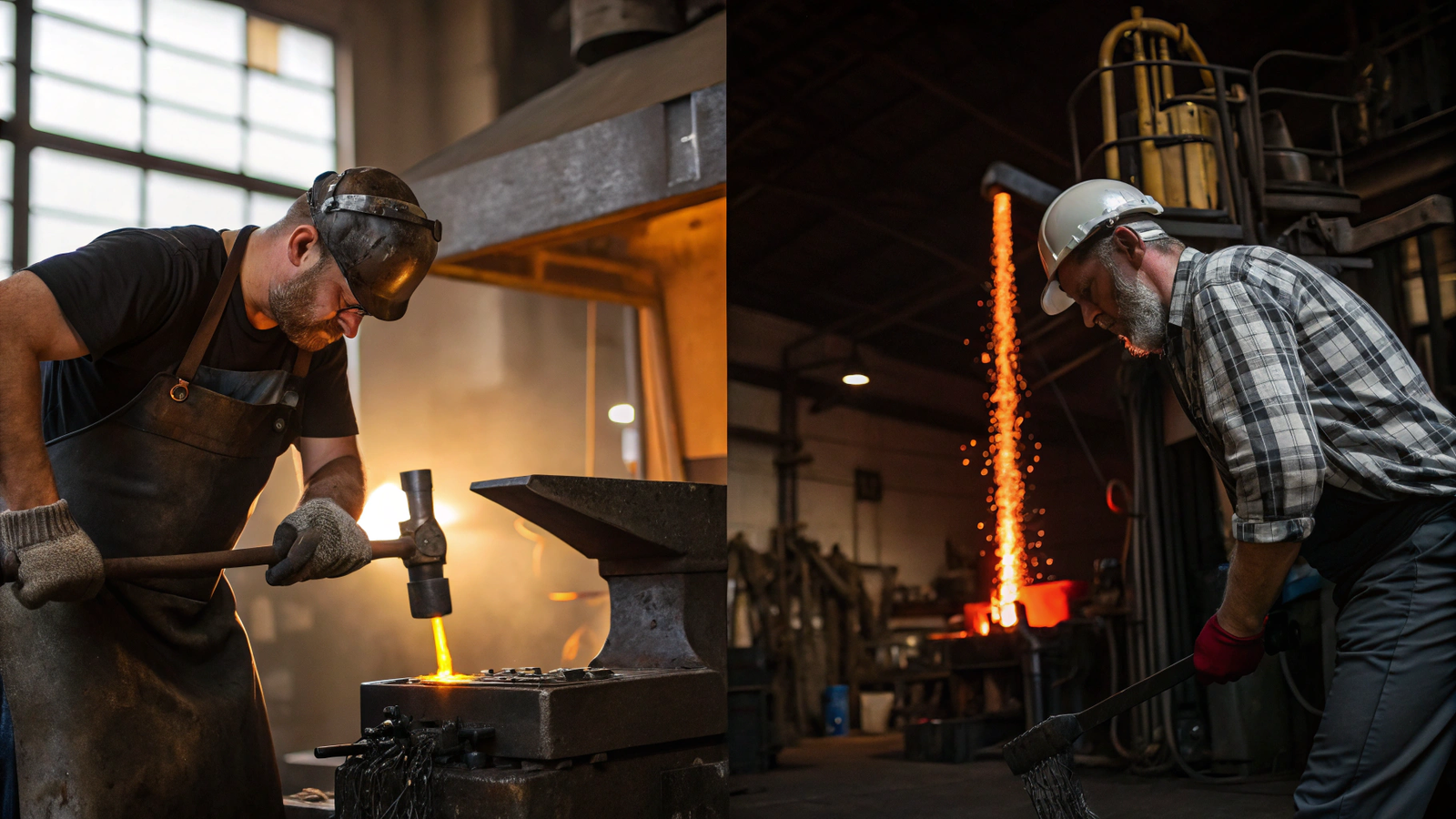
A hand forger is a skilled artisan who shapes metal using manual tools, typically a hammer and an anvil, often heating the metal in a forge. This is a traditional trade.
A hand forger relies entirely on their eye, touch, and experience to control the shape and, to a limited extent, the microstructure of the metal being worked.
I have seen the incredible work done by true hand forgers—their craftsmanship is art. However, that very artistry is the problem for engineering specifications. A hand forger cannot consistently hit the exact temperature zones needed for proper solution treatment4, nor can they apply the precise tonnage required to refine the grain structure of a large aluminum disc evenly across its entire surface. When a trader or machining customer orders material for an application like an aircraft door frame, they need ten thousand identical components, not ten thousand unique pieces of art. The manual process cannot offer the process control or material certification we provide.
Why Hand Forging Fails for Industrial Aluminum Applications Like AHS-2?
Hand forging is perfect for unique, small-scale artistic work where every piece is meant to be one-of-a-kind. Industrial parts, however, demand strict standardization and engineering proof.
The inherent variability of hand forging—in temperature application, force consistency, and final dimension—makes it impossible to provide the necessary quality certifications that demanding sectors require.
For our specialized requirements, such as meeting a proprietary spec like AHS-2, the material must possess guaranteed mechanical properties across the entire component. A hand-worked piece introduces variables: variations in cooling rates, inconsistent compression patterns, and subjective measurement. Our clients, whether they are distributors in the Middle East or precision machining houses, depend on SGS, BV, or TUV reports confirming properties like yield strength and hardness5. Hand forging simply cannot produce a verifiable, repeatable metallurgical signature across a large aluminum ring or disc that would satisfy these rigorous external audits. Our automated, controlled forging ensures every atom is positioned correctly for peak performance.
"Forging", https://en.wikipedia.org/wiki/Forging. A metallurgical reference defines forging as a forming process in which metal is plastically deformed under compressive forces, supporting the article’s basic definition of forging. Evidence role: definition; source type: encyclopedia. Supports: Forging means shaping metal using localized compressive forces.. ↩
"[PDF] Literature Review of Metal Additive Manufacturing Defects", https://nvlpubs.nist.gov/nistpubs/ams/NIST.AMS.100-16.pdf. Foundry and materials references describe porosity as a common casting defect caused by gas entrapment or solidification shrinkage, supporting the statement that cast metal can contain voids or porosity. Evidence role: mechanism; source type: education. Supports: Cast metal often contains voids or porosity.. Scope note: Porosity is common but not inevitable; modern casting controls can reduce or eliminate unacceptable porosity for many applications. ↩
"Hot forging (closed die) | OpenLearn - The Open University", https://www.open.edu/openlearn/science-maths-technology/engineering-technology/manupedia/hot-forging-closed-die. Manufacturing and metallurgy references classify common forging operations into open-die, impression-die, and closed-die processes, supporting the article’s process taxonomy. Evidence role: definition; source type: education. Supports: Modern industrial forging is commonly categorized as open-die, impression-die, and closed-die forging.. Scope note: Some references treat impression-die and closed-die forging as overlapping categories, so terminology may vary by source. ↩
"Heat Treating of Aluminum Alloys", https://materialsdata.nist.gov/bitstream/handle/11115/192/Heat%20Treating%20of%20Aluminum%20Alloys.pdf?sequence=3&isAllowed=y. Metallurgy references define solution heat treatment as heating an alloy within a specified temperature range, holding it long enough for soluble phases to dissolve, and then quenching, supporting the need for controlled thermal conditions. Evidence role: definition; source type: education. Supports: Proper solution treatment requires controlled temperature conditions.. Scope note: This supports the importance of temperature control for solution treatment generally, not the specific inability of every hand forger to achieve it. ↩
"Mechanical Testing - Industrial Inspection & Analysis (IIA)", https://industrial-ia.com/iia-laboratory-services/mechanical-testing/. Accreditation and testing references describe third-party inspection and laboratory testing as methods for verifying mechanical properties such as hardness and tensile properties, supporting the role of independent reports in industrial quality assurance. Evidence role: general_support; source type: institution. Supports: Industrial customers may rely on third-party reports to confirm properties such as yield strength and hardness.. Scope note: The source would support the general function of third-party testing, not the specific practices of the named companies or every customer sector. ↩